A controlled human experiment
GHK hair-growth results
The lower tested concentration had the larger reported hair-count increase. That is the detail that makes me want to stay with this paper.
The tested preparation
The hair-growth study followed 45 men with androgenetic alopecia over 6 months. It tested a topical complex of 5-aminolevulinic acid and glycyl-histidyl-lysine, or GHK, against placebo.
The preparation has first claim on my attention. This was a GHK-containing complex, rather than a trial of pure GHK-Cu. An account that credits the result entirely to the copper peptide would be asking a different preparation to inherit the finding.
I like having a controlled human experiment to examine, but the existence of a control does not resolve that attribution problem. It tests the preparation that actually went into the trial. That gives the paper a useful, bounded question.
Reported hair-count increases
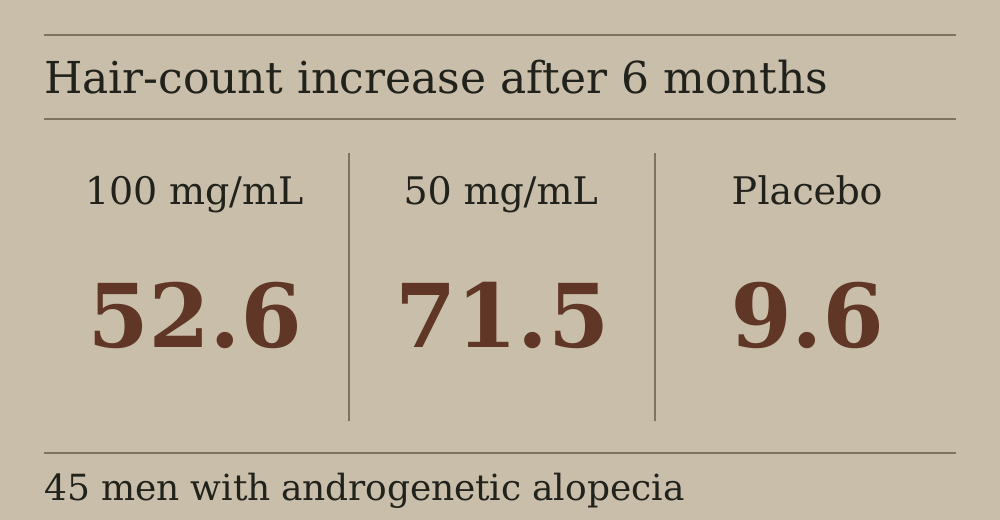
The reported hair-count increases were 52.6 at 100 mg/mL and 71.5 at 50 mg/mL, compared with 9.6 for placebo. The trial reported a statistically significant difference versus placebo, with p<0.05.
The lower tested concentration had the larger increase. The ordering puzzles me enough to want it repeated. A result from this trial cannot establish an ideal concentration on its own. The figures describe what its study groups received and what was reported; they give no instruction for personal use.
The picture below holds the reported increases together. To my eye, seeing all the groups at once makes the oddity harder to miss, while the preparation and study duration remain attached to it.
Replication and attribution
The paper reported no adverse events in any group. That is a result from this study, with its participants and duration. I attach provisional weight to both the efficacy pattern and the safety observation until a larger repetition is available.
The experiment I would be keen to see would compare the combination with its individual components under the same conditions. That is a suggestion for further research. It would help answer the attribution question that sits at the start of this essay.
For all those qualifications, the paper earns its place here. A controlled result can be worth attention while leaving the contribution of each ingredient unresolved. A precise attribution question seems a better souvenir of this paper than a general conviction about hair growth.